From fragmented trial evidence to decision-ready intelligence: why harmonization matters
There is no shortage of clinical trial information. Publications, conference presentations, trial registries, company disclosures and scientific posters can all help organizations track competitors, assess emerging therapies and make strategic decisions.
But having more data does not always make the picture clearer. Results may come from different patient populations, dose cohorts, biomarker-defined subgroups or data cuts. For example, in Phase 1 studies both VCN-01 and TS-1 reported around 50% objective response rate (ORR), but VCN-01 was used to treat patients with advanced refractory disease, whereas TS-1 was in previously untreated patients with advanced pancreatic cancer. This additional context completely changes the lens through which the data should be considered and means the data is not directly comparable.
If those differences are overlooked, comparisons between therapies can be misleading. The consequences can reach well beyond the analysis itself, shaping portfolio strategy, clinical development, partnering and investment decisions.
Making fragmented evidence useful
Beacon Consulting recently worked with a global biopharmaceutical company that wanted a clearer view of the clinical evidence across an oncology landscape.
The aim was to bring the available evidence together and use it to benchmark the competitive landscape. First, though, the team needed to work out which results could fairly be compared.
Finding the evidence was only part of the job. Making sense of it was harder.
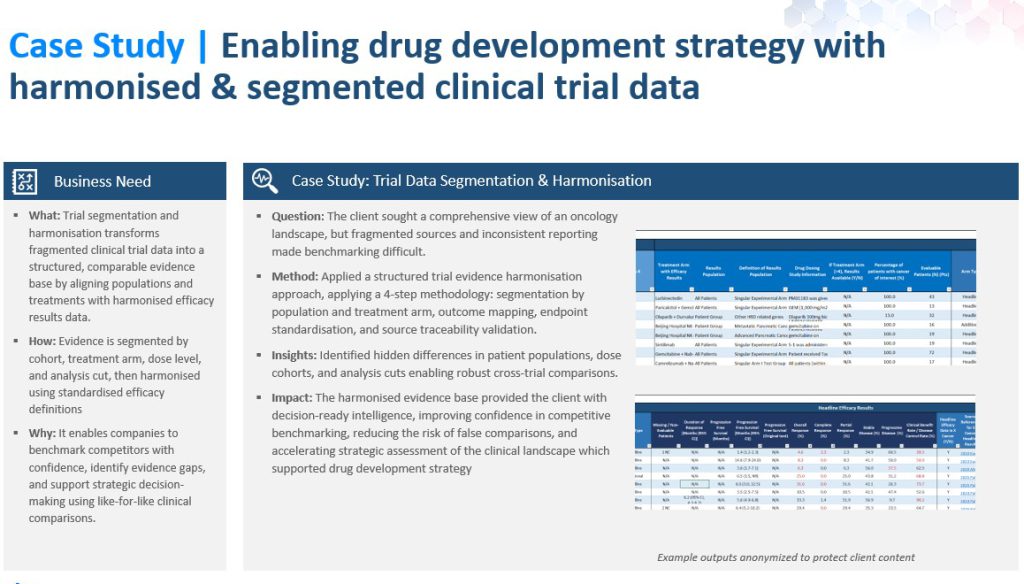
The evidence was scattered across publications, congress abstracts, posters and trial registries. Some results were reported for whole trials, others for individual cohorts or treatment arms. Endpoint definitions also varied, and important context was sometimes tucked away in supplementary materials. Before the team could make reliable comparisons, it had to separate the results into the right groups and bring the reporting into a consistent format.
AI helped speed up the work of extracting, sorting and processing the evidence. But it could not decide on its own whether two outcomes belonged in the same comparison. That called for scientific judgement and knowledge of the therapeutic area.
Beacon Consulting brought together its proprietary platform, AI-enabled workflows and expert scientific review to make the evidence easier to identify and compare. The team:
- Segmented evidence by patient population, treatment arm, dose cohort and analysis cut
- Mapped outcomes back to the correct clinical context
- Standardized endpoint definitions and reporting conventions
- Maintained full traceability to original sources and supporting evidence
The result was not just one place to find the data. It was a clearer basis for comparing it.
With the evidence organized in its clinical context, the client had a clearer view of the competitive landscape and could benchmark relevant assets and clinical programs with greater confidence.
What this means for intelligence leaders
Fragmented clinical data is a familiar problem. It matters more as competitive landscapes become more complex and the amount of available evidence keeps growing.
When evidence is organized at the right level of detail, it is easier to spot gaps, avoid misleading comparisons and draw sound conclusions. For intelligence leaders, that brings three practical benefits:
- More accurate competitive benchmarking: Compare therapies on a like-for-like basis, reducing the risk of misleading conclusions driven by differences in study populations, endpoints or data cuts.
- Clearer identification of opportunities and gaps: Reveal areas of competitive differentiation, unmet need and evidence gaps that may otherwise remain hidden within fragmented datasets.
- Greater confidence in strategic decision-making: Generate more robust insights to support asset evaluation, portfolio prioritization, clinical development planning and business development activities.
The most useful clinical dataset is not always the biggest. It is the one people can trust when making decisions.
Learn More About Consulting
- We are specialist life sciences market research and consultants, delivering tailored insights across the full drug development and commercialisation lifecycle.
- Combines scientific expertise, expert networks, and proprietary Beacon data to transform complex data into clear, strategic decisions.
- Provides fully customised research, spanning qualitative interviews, quantitative analysis, and desk research, aligned to your specific business objectives.
- Helps biopharma teams reduce risk, identify opportunities, and accelerate decision-making with actionable, decision-ready insights.
What is Beacon?
Beacon is the essential intelligence platform for R&D decision-makers working in pharma and biotech, offering unique technology and drug datasets for complex therapeutics and disease areas.
Our market-defining proprietary ontologies, manual data curation, and accurate and comprehensive life science data, provide our customers with unparalleled visibility of the drug, trial and commercial landscape.
This is why 24 of the top 25 pharmaceutical companies trust Beacon to power their critical pipeline, competitive, and commercial decisions.
We’d welcome the opportunity to show you how Beacon can transform your data strategy. Book your personalized demonstration today!