The cell therapy market is moving quickly, butknowing which developments warrant your attention is increasingly difficult.
This executive summary gives you a focused view of the signals most likely to influence strategic decision making, from the rapid growth of in vivo CAR and renewed clinical momentum to changing development priorities and next-generation engineering. In just a few minutes, you will gain a clearer picture of where the market is heading and what it could mean for your pipeline, portfolio and competitive position.
Key Insights Shaping the Cell Therapy Development Market

In Vivo CAR is Moving to the Forefront
In vivo CAR therapies grew by 78.2% in H1 2026, more than any other therapeutic class. Lower manufacturing costs, shorter treatment timelines and encouraging early data are driving momentum.

Clinical Activity is Accelerating Again
A total of 536 trials were registered to start or had started in 2026, up 33.3% from the same period in 2025. China accounted for 254, reinforcing its growing influence on global development.

Innovation is Expanding Beyond Conventional CAR T
Non-CAR and non-TCR therapies represented 66.6% of 2026 approvals, while 102 newly disclosed assets used armoring strategies to improve durability, persistence and performance.
78.2% Growth.
In Vivo CAR Takes the Lead.
Therapeutic Class Distribution Growth in H1 2026
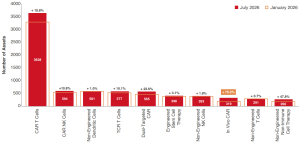
*Assets with multiple therapeutic classes were counted once per therapeutic class
CAR T cells remain the largest therapeutic class, accounting for 30.9% of current cell therapy assets. As seen in the graph, in vivo CAR therapies experienced the biggest growth in H1 2026, with a 78.2% increase from January. This transformative shift is driven by the promise of lower manufacturing costs and shorter time-to treatment, as well as encouraging early preclinical and clinical data. Legend Biotech reported promising results of its in vivo CD19/CD20 dual-targeting CAR T therapy LB2501 at the EHA Congress 2026, demonstrating an ORR of 100% and CR of 83.3% among six patients receiving DL2 in the phase 1 trial investigating relapsed/refractory non-Hodgkin lymphoma. The growing interest in the space was also reflected at ASGCT 2026, where in vivo CARs were a dominant theme with higher visibility than traditional ex vivo cell therapy approaches.
Meanwhile, CAR NK cells surpassed non-engineered dendritic cells to become the second-most-prevalent therapeutic class, likely due to their favorable safety profile, with lower risk of graft-versus-host disease and cytokine release syndrome compared to CAR T therapies. Artiva Biotherapeutics reported AlloNK data at the EULAR Congress 2026 across various abstracts, posters, and presentations, showing that the therapy led to deep B-cell depletion with no CRS, ICANS, or treatment-related serious adverse events. AlloNK received RMAT designation in June 2026 from the FDA for the treatment of refractory rheumatoid arthritis in combination with rituximab, highlighting regulatory confidence in the therapy.
Target Strategies Are Shifting Beyond the Familiar.
Engineered assets make up 75.6% of the landscape, and among these, 63.1% have disclosed targets, a 4% decrease from January 2026, when 67.1% of therapies had a disclosed target. Among disclosed active assets, CD19 and BCMA were the top targets, accounting for 13.9% and 5.3%, respectively. MSLN, BCMA, and B7- H3 showed increased growth in 2026. SIGLEC2 and SIGLEC3 recorded a slight decrease in assets actively investigating these targets, which may be linked to 2026 disease trends, as SIGLEC2 is a validated target against B-cell malignancies, which was not among the most prominent indications, or may reflect portfolio optimisation. Growth in MSLN-targeted programs highlights ongoing efforts to address solid tumours, where mesothelin is highly expressed across multiple difficult-to-treat indications. AdCella announced a collaboration with Shanghai Cell Therapy Group in January 2026 to co-develop BZDS1901, a notable antibody-armed MSLN-specific CAR T cell therapy investigating mesothelioma, lung and gynaecological tumors.
Target Growth of Active Assets in H1 2026
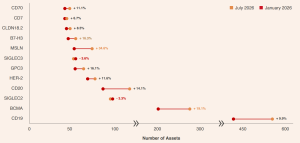
There is a further total of 2508 and 2006 assets with a target of ‘Undisclosed’ or ‘Not Applicable’, respectively. ‘Undisclosed’ denotes genetically engineered therapies with no publicly disclosed receptor target, whereas ‘Not Applicable’ refers to non-engineered cell therapies that have not been subject to antigen-specific conditioning.
536 Trials. Clinical Momentum is Back.
There have been 536 trials registered to start or have started in 2026 so far, a 33.3% increase compared with the same period in 2025 (402 trials). In the January landscape review, trial initiation growth appeared to taper, declining from 25% between 2023 and 2024 to 13.3% between 2024 and 2025. However, initial 2026 data seems to suggest trial initiation may be accelerating once again with renewed momentum driven by increased interest in in vivo therapies and solid tumor indications. Of the trials initiated in 2026, 254 are located in China, accounting for just under half of the total registered trials. Following China, 108 trials are located in the United States, with a significant drop to European locations, with only 11 and 12 trials located in Spain and Germany, respectively. This landscape reflects China’s sustained leadership in cell therapy development, supported by favorable regulatory policies, lower costs, and a large and accessible patient pool.
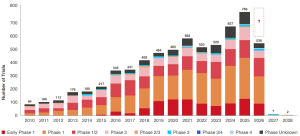
A Broader Approval Wave is Taking Shape.
2026 has marked continued progress in cell therapy development, with multiple regulatory approvals including raguneprocel, marne-cel, and TREGZI™. 66.6% of approvals in 2026 are non-CAR and TCR-related approvals, reflecting the diversification of the cell therapy pipeline beyond conventional CAR T approaches, spanning regenerative medicine, genetic diseases, and immune disorders. Anbal-cel and satri-cel both crossed major milestones for the space, as the recent infographic on RIMQARTO® details it as the first-armored CAR T to gain approval, and satri-cel becomes the first CAR T approved for solid tumor indications, highlighted in the June Cell Therapy Digest on CAR Therapies for Solid Tumors. If more therapies reach approval in 2026, it may be a pivotal year for the space, that could result in a second wave similar to the biologics space.
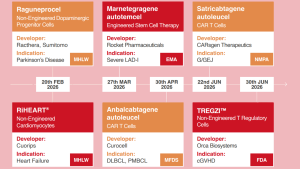
MHLW= Japan’s Ministry of Health, Labor and Welfare
MFDS = South Korea’s Ministry of Food and Drug Safety
DLBCL = Diffuse Large B-Cell Lymphoma
PMBCL = Primary Mediastinal Large B-Cell Lymphoma
LAD-I = Leukocyte Adhesion Deficiency-I.
G/GEJ = Gastroesophageal Junction Adenocarcinoma
102 New Assets. Engineering Moves Up the Agenda.
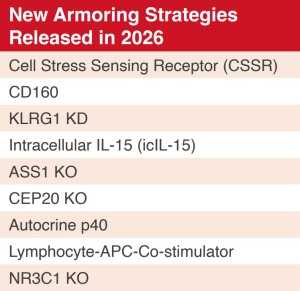
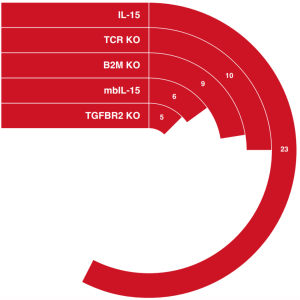
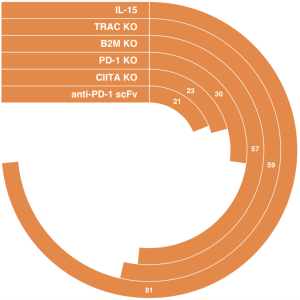
In 2026, 102 newly disclosed assets leveraged armoring strategies, particularly IL-15 secretion, to significantly improve CAR T durability and persistence. Cytokine armoring is an attractive engineering addition to reprogram cell phenotypes, transform harsh tumor microenvironments, or work in conjunction with promoter systems to suppress expression of potent cytokines1. PSDR CAR T cells entered the cell therapy space this year with a phase unknown trial investigating lung cancer. The multi-targeted CAR T cell therapy secretes anti-PD-1 scFv antibodies, a well-validated regulatory target, using a blocking mechanism at the tumor site to minimize the toxicities associated with the immune checkpoint blockade. The table below lists some new armoring techniques introduced to Beacon Cell Therapy at the 2026 ASGCT and AACR meetings and trial registries.
Top Armoring Strategies in New Assets
1Sek, K. et al. (2026) Cell Biology, 104(5), pp. 485–489. doi:10.1111/imcb.7011211
Top Armoring Strategies in Active Assets
Conclusion
H1 2026 signals a cell therapy development market that is not only growing, but becoming more selective and technologically advanced.
In vivo delivery is gaining traction, trial initiation has rebounded and developers are increasingly looking beyond conventional CAR T approaches through alternative cell types, differentiated targets and next-generation engineering. Together, these shifts point to a more diverse market in which clinical and commercial advantage will depend on understanding where genuine differentiation is beginning to emerge.
Better Data.
Smarter Decisions.
Stronger Pipelines.
Beacon transforms complex drug development data into intelligence your teams can act on. Go beyond generic market tracking with scientist curated, modality-specific insights that reveal emerging opportunities, competitive threats and the factors driving differentiation. Our structured, AI-ready data connects the full development landscape, giving your organisation a trusted foundation for faster analysis, scalable workflows and stronger decisions from discovery through to portfolio strategy.
Need the Detail
Behind the Headlines?
This executive summary is designed to give you the key takeaways quickly. When you are ready to look deeper, the full H1 2026 Cell Therapy Landscape Review provides the evidence and analysis behind these market shifts, helping you assess emerging opportunities, benchmark your strategy and make more informed portfolio decisions. Explore the full review for an in-depth view of the market, or access Beacon’s wider collection of expert reports, infographics and resources to stay ahead of the developments shaping cell therapy.
Learn More About Cell Therapy
- The Most Comprehensive Way to Search the Cell Therapy Development Landscape: Unique search ontologies based on Cell Therapy drug and trial characteristics
- Market Leading Approach to Cell Therapy Preclinical & Clinical Data Curation: Manual curation of key Cell Therapy research and development data points by Cell Therapy research scientists
- Seamlessly Integrate Commercial & Scientific Data all in One Place: Search Cell Therapy company and deal data based on their pipeline and technologies.
- Unrivalled Granularity in Reports & Analysis: Our search ontology and technology indexing enable comprehensive analysis not seen elsewhere.
What is Beacon?
Beacon is the essential intelligence platform for R&D decision-makers working in pharma and biotech, offering unique technology and drug datasets for complex therapeutics and disease areas.
Our market-defining proprietary ontologies, manual data curation, and accurate and comprehensive life science data, provide our customers with unparalleled visibility of the drug, trial and commercial landscape.
This is why 24 of the top 25 pharmaceutical companies trust Beacon to power their critical pipeline, competitive, and commercial decisions.
We’d welcome the opportunity to show you how Beacon can transform your data strategy. Book your personalized demonstration today!

