
The autoimmune market is expanding quickly, but the most important story is where investment and development activity are beginning to concentrate.
This executive summary gives you a focused view of the signals most likely to influence strategic decision-making, from growing confidence in B-cell-directed approaches and rising late-stage activity to changing investment patterns and emerging preclinical innovation. In just a few minutes, you will gain a clearer picture of where the market is heading and what it could mean for your pipeline, portfolio and competitive position.
Key Signals Shaping The Market

B-Cell-Directed Strategies Are Setting the Pace
CD19, BCMA and CD3 were the leading targets among assets added in H1 2026. Their continued prominence reflects growing confidence in approaches designed to achieve deeper, more durable control of autoimmune disease.

Clinical Momentum is Shifting Towards Immune Reset
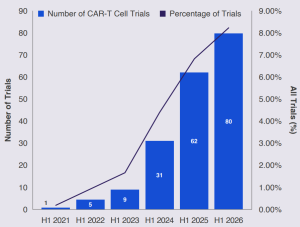
CAR-T trial initiations reached 80 in H1 2026, up from 62 in H1 2025, with activity concentrated in B-cell-mediated diseases. IgAN also experienced a surge in trial initiations as recent approvals strengthened validation of B-cell and APRIL-targeted approaches.

Capital is Following Differentiated Innovation
Private placements increased by 173.1% from H1 2025, while partnerships, licensing agreements and M&A activity also grew. The shift indicates continued interest in external innovation and assets supported by compelling data.
668 New Assets.
B-Cell Depletion Leads the Field.
Top Targets of Drugs Identified in H1 2026 by Status
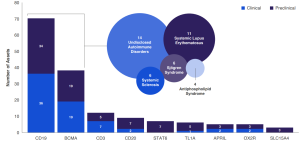
There have been 668 drugs added to Beacon Autoimmune since 2nd January 2026; 267 of these assets are clinical and 401 are preclinical.
The top target of assets added in H1 2026 was CD19, followed by BCMA and CD3, mirroring the leading target profiles observed in H1 2025 and H1 2024. CD19 and BCMA reflect the sustained interest in therapies that aim to achieve deep depletion of autoreactive B-cells and plasma cells, reflecting the growing clinical validation of B-cell directed approaches across autoimmune diseases. CD3 remained the third most common target, demonstrating ongoing investment in T-cell modulation strategies. As a component of the TCR signalling complex, CD3 plays a central role in transmitting activation signals following antigen recognition, making it an attractive target for immune modulation. There were 20 assets dual targeting both BCMA x CD19 and four assets targeting BCMA x CD19 x CD3. The bubbles show the top investigated indication for the assets dual targeting CD19 x BCMA. ‘Undisclosed autoimmune disorders’ was the most frequently reported indication category, reflecting developers’ tendency to disclose a broad autoimmune disease label rather than specific indications. This is followed by SLE, systemic sclerosis (SSc) and Sjögren syndrome (SjD). This further highlights the focus on severe antibody-mediated autoimmune diseases where deep depletion of B-cells and plasma cells could improve treatment by more durable disease control.
80 CAR-T Trials.
Immune Reset Gains Momentum.
New Trials Added by Disease
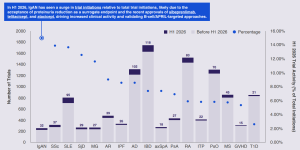
T1D – Type 1 diabetes, AR – Allergic rhinitis, GVHD – Graft-versus-host-disease, ITP – Immune thrombocytopenic purpura
B-cell-mediated autoimmune diseases accounted for a disproportionately large share of new trial initiations in H1 2026 compared with historical activity, with indications such as SLE, SjD and SSc attracting significant investment as clinical validation of B-cell and plasma-cell depletion strategies continues to grow. This shift was further reinforced by increasing activity in the CAR-T cell therapy space, which was heavily concentrated in B-cell-driven diseases and reflects growing confidence in deep immune reset approaches as potentially disease-modifying treatments. At the same time, established markets including AD, IBD, RA and PsO maintained strong development activity, highlighting both their commercial attractiveness and the ongoing need for differentiated therapies despite multiple approved treatment options.
Number of CAR-T Trials
81 Pivotal Trials. Late-Stage Activity Broadens.
Active Pivotal Trials by Disease
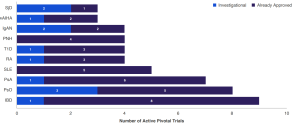
PNH – Paroxysmal Nocturnal Hemoglobinuria, wAIHA – Warm Autoimmune Hemolytic Anemia
New trial initiations and positive clinical progression are increasingly translating into late-stage development activity. Beacon captures 81 active pivotal autoimmune trials. While IBD, PsA, and PsO account for the largest share of pivotal activity, the landscape is increasingly shaped by emerging high-growth indications. SLE maintains strong late stage momentum, and IgAN has rapidly established a pivotal pipeline equivalent to RA and PNH, reflecting heightened investment following regulatory validation and recent market approvals. The pivotal autoimmune landscape remains dominated by large immunology players such as AbbVie, which also ranked as the leading developer of newly added autoimmune assets in H1 2026, demonstrating strength across early and late-stage development. However, the presence of emerging companies with active pivotal trials such as MoonLake and Intellia, demonstrates that smaller companies acquire funding to progress assets into late-stage development, given they have compelling clinical data and clear differentiation. Finally, pivotal development activity is increasingly focused on label expansion and lifecycle management of approved therapies, reflecting the continued value of validated mechanisms
| Developer | No. Pivotal Trials |
|---|---|
| AbbVie Ltd | 2 |
| Hoffmann-La Roche AG | 2 |
| Johnson & Johnson | 2 |
| Novartis Pharmaceuticals AG | 2 |
| Ipsen Biopharmaceuticals Inc | 2 |
| Sanofi | 2 |
| AstraZeneca PLC | 2 |
| MoonLake Immunotherapeutics AG | 2 |
| Eli Lilly and Company | 2 |
| Intellia Therapeutics, Inc. | 2 |
| Alkermes plc | 2 |
H1 2026 Pivotal Trial Initiation Highlight
BHV-1300 is a first-in-class autoantibody degrader. Following encouraging phase 1 results showing reductions in pathogenic autoantibodies and normalisation of thyroid hormones in Graves’ disease, the phase 3 study will assess whether BHV-1300 can induce drug-free euthyroidism while maintaining a favourable safety profile.
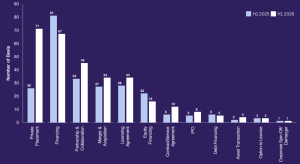
Private Placements Surge 173.1%.
There has been a shift in the deal type landscape from H1 2025 to H1 2026. Unspecified financing remained a leading deal type, but private placements emerged as the most common deal type, increasing by 173.1%. IPO activity also increased, despite a wider market decline in the number of IPOs, suggesting growing investor confidence in selected healthcare and biotech companies. Simultaneously, partnership and collaboration and licensing agreements increased, showing interest in risk-sharing models and external innovation. Mergers and acquisitions (M&As) also increased as large biopharma companies are preferring to invest in external innovation backed by positive data. In addition to the two M&As shown on the previous slide, Eli Lilly completed its acquisition of Centessa Pharmaceuticals for $7.8 B where they will be using Centessa’s orexin receptor 2 agonists for the treatment of narcolepsy. This highlights that large pharmaceutical companies are willing to pursue significant acquisitions to strengthen their pipelines.
The overall trends show that companies are balancing strategic partnering and acquisitions to advance their development programmes and expand their portfolios.
Number of Deals by Deal Type in H1 2026 vs H1 2025
Three Emerging Assets. New Routes to Immune Reset.
mRNA-6007
Developer: Moderna Therapeutics
Disease Indications: Autoimmune Disorders, Systemic
Lupus Erythematosus Therapeutic Class: CAR-T Cells, mRNA-Enhanced Cell Therapy, In Vivo CAR
Target: Undisclosed
Why Track? Represents an immune-reset strategy

Sanofi In Vivo CD19 CAR T Program
Developer: Sanofi
Disease Indications: Autoimmune Disorders
Therapeutic Class: mRNAEnhanced Cell Therapy, CAR-T Cells, In Vivo CAR
Target: CD19
Why Track? A potentially scalable in vivo CAR-T option for autoimmune disorders
BridGene Biosciences SLC15A4 inhibitor
Developer: BridGene Biosciences
Disease Indications: Systemic Lupus Erythematosus, Rheumatoid Arthritis, Autoimmune Disorders
Therapeutic Class: Small Molecule Therapy
Target: SLC15A4
Why Track? SLC15A4 provides a novel target option for SLE and other interferon-driven diseases rather than directly blocking downstream cytokines
Conclusion
H1 2026 points to an autoimmune market increasingly shaped by deeper immune intervention, stronger clinical validation and more selective investment.
B-cell and plasma-cell depletion strategies are attracting sustained attention, CAR-T activity is accelerating and high-growth indications such as SLE and IgAN are gaining strategic importance. Alongside a broader late-stage pipeline and increased deal activity, these shifts suggest that future advantage will depend on identifying which targets, technologies and development strategies can deliver meaningful differentiation in an increasingly competitive market.
Better Data.
Smarter Decisions.
Stronger Pipelines.
Beacon transforms complex drug development data into intelligence your teams can act on. Go beyond generic market tracking with scientistcurated, disease specific insights that reveal emerging opportunities, competitive threats and the factors driving differentiation. Our structured, AI-ready data connects the full development landscape, giving your organisation a trusted foundation for faster analysis, scalable workflows and stronger decisions from discovery through to portfolio strategy.
Need the Detail
Behind the Headlines?
This executive summary is designed to give you the key takeaways quickly. When you are ready to look deeper, the full H1 2026 Autoimmune Landscape Review provides the evidence and analysis behind these market shifts, helping you assess emerging opportunities, benchmark your strategy and make more informed portfolio decisions. Explore the full review for an in-depth view of the market, or access Beacon’s wider collection of expert reports, infographics and resources to stay ahead of the developments shaping autoimmune drug development.
Learn More About Autoimmune
- The Most Comprehensive Way to Search the Autoimmune Drug Development Landscape: Unique search ontologies based on Autoimmune drug and trial characteristics
- Market Leading Approach to Autoimmune Preclinical & Clinical Data Curation: Manual curation of key Autoimmune research and development data points by Autoimmune research scientists
- Seamlessly Integrate Commercial & Scientific Data all in One Place: Search Autoimmune company and deal data based on their pipeline and technologies.
- Unrivalled Granularity in Reports & Analysis: Our search ontology and technology indexing enable comprehensive analysis not seen elsewhere.
What is Beacon?
Beacon is the essential intelligence platform for R&D decision-makers working in pharma and biotech, offering unique technology and drug datasets for complex therapeutics and disease areas.
Our market-defining proprietary ontologies, manual data curation, and accurate and comprehensive life science data, provide our customers with unparalleled visibility of the drug, trial and commercial landscape.
This is why 24 of the top 25 pharmaceutical companies trust Beacon to power their critical pipeline, competitive, and commercial decisions.
We’d welcome the opportunity to show you how Beacon can transform your data strategy. Book your personalized demonstration today!

